

Microsoft 365 CSP vs. Direct Microsoft Billing: How Buying via an Authorized Partner Saves Costs in the GCC
Cloud Procurement, Microsoft CSP, GCC IT Budgeting
Key Project Outcomes & Proven Impact
Jump to section
Compare Microsoft 365 CSP billing with direct Microsoft web-direct purchases. Discover how GCC enterprises save on FX fees, reclaim local VAT, unlock NCE seat flexibility, and receive localized Tier-1 support through an authorized partner.
When deploying Microsoft 365 across an organization in the GCC, finance directors and IT managers face a fundamental procurement question: should the company pay Microsoft directly via the Microsoft 365 Admin Center using a corporate credit card, or procure licenses through an authorized Microsoft Cloud Solution Provider (CSP)?
On the surface, license retail prices appear nearly identical. However, purchasing directly from Microsoft via standard "Web-Direct" agreements introduces hidden transaction overheads, accounting headaches, rigid contract lock-ins, and offshore support delays.
For companies operating in the UAE, Saudi Arabia, Qatar, Oman, and Bahrain, procuring Microsoft 365 through an authorized local Tier-1 CSP partner offers decisive operational, tax, and bottom-line financial advantages.
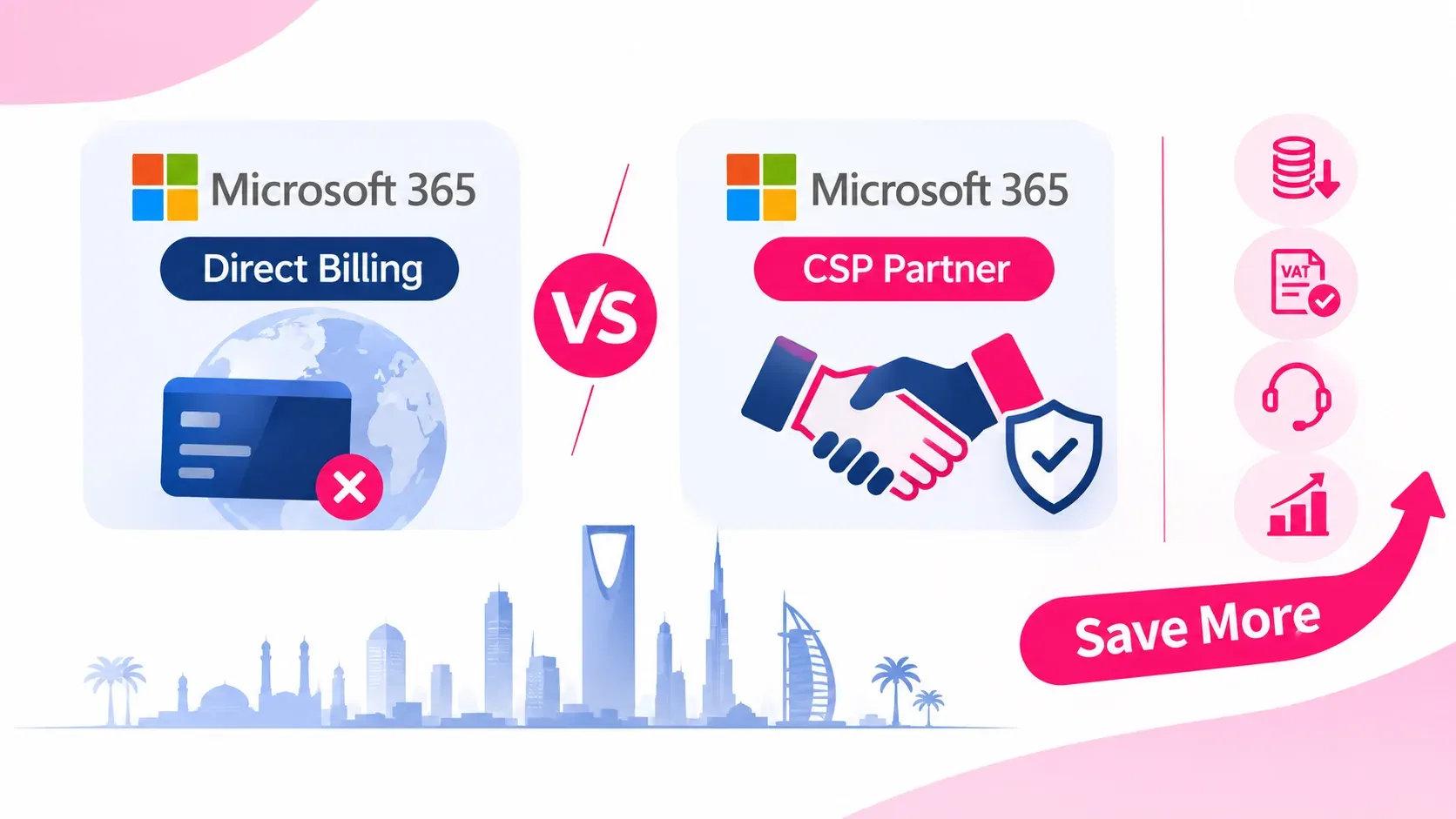
The Core Differences: Direct Billing vs. CSP Partner Invoicing
| Procurement Feature | Microsoft Direct (Web-Direct) | Authorized Tier-1 CSP Partner |
|---|---|---|
| Payment Method | Corporate Credit Card / Wire transfer | Local Bank Transfer, Cheque, or Flexible Credit Terms |
| Invoicing Currency | Often USD / EUR (subject to bank FX conversion) | Local Currency (AED, SAR, OMR, etc.) |
| Tax Invoicing & VAT | Foreign billing entity; complex FTA/ZATCA VAT filing | Fully compliant local Tax Invoices with TRN / ZATCA QR |
| Commitment Flexibility (NCE) | Strict automated enforcement; manual tier tracking | Strategic advisory, mid-term license shifting, pooling |
| Technical Support | Global queue; offshore ticketing; slow SLA for standard tiers | Direct localized Tier-1 & Tier-2 engineers with fast SLAs |
| Licensing Optimization | None (Microsoft bills for active subscriptions regardless of use) | Routine license pruning, hybrid tiering, and security audits |
1. Eliminating Foreign Exchange (FX) & Credit Card Surcharges
When buying directly through the Microsoft admin portal, organizations are typically billed through offshore legal entities. For GCC-based companies, this triggers multiple hidden transaction fees:
- Bank Foreign Transaction Fees: Most regional corporate credit cards levy an international transaction surcharge ranging from 1.75% to 3.5% on foreign vendor payments.
- Currency Conversion Fluctuations: Even when billed in a pegged local currency, foreign merchant processing channels often run secondary conversion spreads that inflate monthly overhead.
- Credit Limit Bottlenecks: High-seat enterprise renewals tie up operational credit card balances that are better reserved for emergency operational spend.
The CSP Advantage: Authorized partners bill locally in your operating currency (AED, SAR, QAR, or OMR) via local bank transfer or corporate purchase orders (POs), entirely bypassing banking surcharges and credit card transaction fees.
2. Tax Compliance: Seamless VAT Reclaims with FTA and ZATCA
For finance teams in the UAE and Saudi Arabia, tax invoice compliance is non-negotiable.
Direct Microsoft invoices are often generated by offshore entities (such as Microsoft Ireland Operations Ltd). These invoices frequently lack required local elements, creating obstacles for claiming input tax credits:
- Missing the local buyer/seller Tax Registration Number (TRN) in the exact format required by the UAE Federal Tax Authority (FTA).
- Failing to provide ZATCA Phase-2 compatible cryptographic QR codes and XML invoice structures required by the Zakat, Tax and Customs Authority in Saudi Arabia.
Purchasing through an authorized local CSP partner ensures that every invoice issued is a legitimate, fully compliant local tax invoice. Your accounting team can immediately reclaim 100% of the input VAT without risking audit penalties or rejection by regional tax authorities.
3. Navigating the New Commerce Experience (NCE) Without Penalty
Microsoft’s New Commerce Experience (NCE) framework penalizes companies that do not plan their seat allocations carefully:
- Annual Commitments: Offer lower pricing but lock you into paying for seats for an entire 12-month period. If an employee departs or headcount is downsized, you must continue paying for that unassigned license.
- Monthly Commitments: Offer month-to-month seat elasticity, but carry a 20% price premium across all tiers.
A competent CSP partner actively manages your NCE risk. By analyzing your baseline core headcount versus seasonal or contingent project staff, an authorized partner constructs a hybrid NCE model:
- 80% baseline staffing secured on discounted Annual Commitments.
- 20% variable buffer assigned to Monthly Commitments to accommodate staff turnover without paying the 20% surcharge across your entire organization.
4. Localized Tier-1 Support vs. The Offshore Queue
Direct Microsoft Web-Direct support operates on a tiered global queue. Unless your organization purchases an expensive Premier or Unified Support contract (which often costs tens of thousands of dollars annually), standard support tickets are routed offshore.
When your primary Exchange tenant experiences a mail delivery disruption or an Entra ID Conditional Access policy misconfiguration locks executives out of their systems, waiting 8 to 24 hours for an offshore email response can halt operations.
With a regional Tier-1 CSP:
- You gain access to a dedicated support desk staffed by certified local systems engineers.
- Support teams operate within GCC business hours and time zones (UTC+3 / UTC+4).
- Critical incident escalations are managed directly with Microsoft internal partner engineering channels, drastically cutting mean time to resolution (MTTR).
5. Value-Added Advisory and License Hygiene
Microsoft’s direct billing portal will never alert you if:
- 15 departed employees still have active Business Standard licenses assigned to their inactive mailboxes.
- 40 deskless users who only use browser apps are over-licensed on Business Standard instead of Business Basic.
- Your organization is paying for third-party antivirus subscriptions while already paying for Microsoft Defender via existing licenses.
A dedicated CSP partner conducts regular license hygiene reviews. By matching active mailbox consumption, sign-in activity, and device enrollments, partners help companies continuously optimize seat counts and eliminate ghost licenses ahead of renewal dates.
Procurement Checklist: When to Migrate to CSP Billing
Transitioning from Microsoft Direct to CSP billing requires zero downtime, no data migration, and zero disruption to end-user access. Migrating is recommended if your company:
- Employs more than 15 Microsoft 365 users and currently charges monthly licenses to a corporate credit card.
- Operates in the GCC and needs clean, ZATCA/FTA-compliant tax invoices for input VAT reclaims.
- Requires formal commercial credit terms (e.g., 30-day corporate payment terms) instead of immediate card debits.
- Wants a dedicated regional engineering contact rather than generic online support ticket queues.
Frequently Asked Questions
Clear answers to common questions about this guide and implementation.
No. Billing migration occurs strictly at the tenant licensing layer. Your Microsoft 365 tenant, user mailboxes, SharePoint data, and Teams configurations remain completely untouched with zero downtime.
Related Articles
More in Microsoft 365
Microsoft 365 Business Basic vs. Standard vs. Premium: Which Tier Does Your Business Actually Need?
Thursday Nov 5, 2026
Compare Microsoft 365 Business Basic, Standard, and Premium to find the right fit for your organization. Discover the key differences in desktop apps, advanced security, Intune device management, and how a hybrid tier strategy can slash your annual licensing costs.

Cloud vs On-Premise Software: Which Is Better for Your Business in 2026?
Thursday Nov 5, 2026
Choosing between cloud and on-premise software? Understand the differences in cost, security, scalability, maintenance and accessibility to find the right technology solution for your business.

Business Starter Kit: Essential Software Every New Business Needs in 2026
Thursday Nov 5, 2026
Starting a business in 2026? Discover the essential software, accounting, CRM, cybersecurity and productivity tools every new business needs to operate efficiently and grow.


